Iconoclast: A Neuroscientist Reveals How to Think Differently by Gregory Berns Ph.d
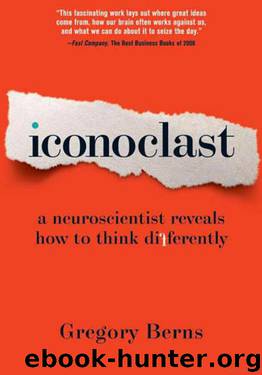
Author:Gregory Berns Ph.d. [Berns, Gregory Ph.d.]
Language: eng
Format: epub
Tags: Industrial & Organizational Psychology, Creative Ability, Management, Neuropsychology, Religion, Medical, Behavior - Physiology, General, Thinking - Physiology, Psychophysiology - Methods, Risk-Taking, Neuroscience, Psychology; Industrial, Fear, Perception - Physiology, Iconoclasm, Business & Economics, Psychology
ISBN: 9781422133309
Google: IQgAgvMI3GcC
Amazon: 1422133303
Publisher: Harvard Business Press
Published: 2010-03-17T07:00:00+00:00
How Fear Clouds Financial Judgment
Identifying differences in brain activation in the laboratory is one thing, but demonstrating that these differences have any practical application in the real world is an entirely different matter. Andrew Lo, a professor of finance at the MIT Sloan School of Management, has been examining the link between biology and financial decision making. Lo’s work is at the cutting edge of neuroeconomics and represents some of the most intriguing directions in which both neuroscience and biological information are being applied in the business world. Lo believes in the general principle of the efficient market, but because some individuals seem to do better than others, he has explored the possibility that biological differences underlie the performance inequities between winners and losers seen in any market. Although markets might be broadly efficient, Lo’s work suggests that differences between individuals in the market create small, but transiently leverageable opportunities for profit. The key lies in the emotional brain, especially fear circuits.
In 2001, Lo teamed up with a young Russian physicist/cognitive neuroscientist, Dmitry Repin, to measure physiological responses in professional traders.10 Lo and Repin recruited a small group of traders who worked in the foreign-exchange and interest-rate derivatives unit of a major global financial institution based in Boston. On a typical day, this unit engaged in 1,000–1,200 trades and averaged $3 million to $5 million per trade. Lo and Repin wired up ten traders to measure a range of physiological responses that included blood pressure, body temperature, respiration rate, skin conductance responses (sweating), and measurements of muscle contractions in the face and arm. These measurements were collected for a period ranging from forty-nine to eighty-three minutes during live trading hours. After the session, Lo and Repin examined the correlation between these physiological parameters and specific volatility events in the market. Lo and Repin used a computer algorithm to extract these events in markets that traded foreign currencies, including the euro, the Japanese yen, and the British pound. The volatility events included price deviations, spread deviations, price-trend reversals, and both price and return volatility. Lo and Repin also divided the traders into inexperienced and seasoned categories to see whether experience affects an individual’s autonomic reactions to market events.
Although this was a small sample of subjects, Lo and Repin found surprising correlations between physiological responses and market trends. The most strongly correlated parameter, blood pressure, rose in both novice and experienced traders when an asset’s maximum volatility went up. Volatility was measured as the difference between the maximum and minimum price over a short time interval and calculated as a fraction of the average price. It was related to the short-term variance of the asset. In a more detailed analysis, they found that this rise in blood pressure occurred well in advance of the key volatility event. This suggested that the traders’ bodies responded to cues in the market that preceded the large-scale event that subsequently showed up as a price change. This observation raises the intriguing possibility that the brain (and the body) picks up subtle cues in the market that are not apparent from trend analyses.
Download
This site does not store any files on its server. We only index and link to content provided by other sites. Please contact the content providers to delete copyright contents if any and email us, we'll remove relevant links or contents immediately.
Rewire Your Anxious Brain by Catherine M. Pittman(18658)
Talking to Strangers by Malcolm Gladwell(13376)
The Art of Thinking Clearly by Rolf Dobelli(10495)
Mindhunter: Inside the FBI's Elite Serial Crime Unit by John E. Douglas & Mark Olshaker(9348)
Becoming Supernatural by Dr. Joe Dispenza(8225)
Change Your Questions, Change Your Life by Marilee Adams(7788)
Nudge - Improving Decisions about Health, Wealth, and Happiness by Thaler Sunstein(7712)
The Road Less Traveled by M. Scott Peck(7606)
The Lost Art of Listening by Michael P. Nichols(7509)
Mastermind: How to Think Like Sherlock Holmes by Maria Konnikova(7353)
Enlightenment Now: The Case for Reason, Science, Humanism, and Progress by Steven Pinker(7316)
Win Bigly by Scott Adams(7204)
The Way of Zen by Alan W. Watts(6621)
Daring Greatly by Brene Brown(6520)
Big Magic: Creative Living Beyond Fear by Elizabeth Gilbert(5780)
Grit by Angela Duckworth(5623)
Ego Is the Enemy by Ryan Holiday(5455)
Men In Love by Nancy Friday(5250)
The Laws of Human Nature by Robert Greene(5214)
